

Can stand-up pouches hold liquid without leaking?
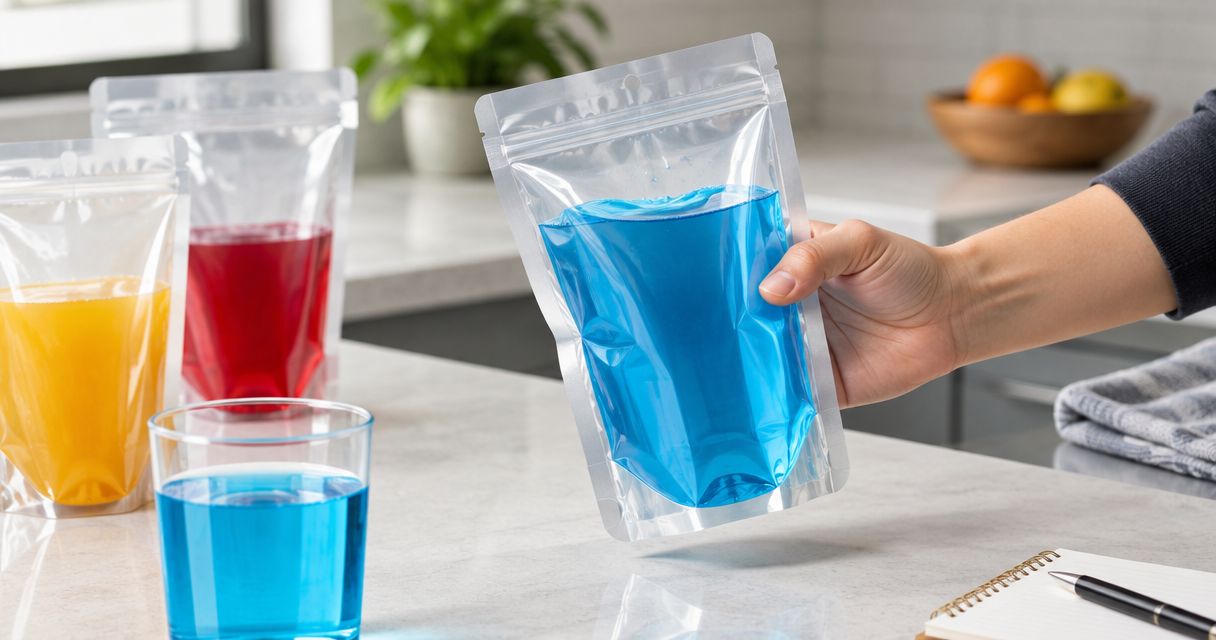
Yes, stand-up pouches can hold liquid without leaking when the film, seals, and closure are designed for the contents and validated under actual filling, storage, and shipping conditions. A pouch that stands upright or has a zipper is not automatically liquid-tight; the complete filled package needs testing.
- Can stand-up pouches hold liquid? Yes, but film compatibility, seal integrity, and closure performance determine whether they leak.
- A zipper alone does not establish liquid-tight performance; validate the finished package with its actual contents.
- ASTM F88/F88M evaluates seal strength; ASTM F2096 addresses gross leaks using internal pressurization.
- Approve the pouch specification and filled-package tests before ordering a production run.
Can stand-up pouches hold liquid without leaking?
Yes—but specify a liquid package, not simply a stand-up pouch. The bottom gusset provides the standing shape. It does not establish whether the film, closure, or finished seals will contain your formulation throughout distribution.
For a 2026 packaging order, separate the package's shape from its performance requirements. Hale Path Packaging supplies custom flexible packaging; your purchasing brief should identify the liquid, filling process, dispensing method, and required validation rather than requesting an unspecified pouch.
The closure is an early decision because it changes how you fill, seal, dispense, and reclose the package.
| Format | Best for | Practical advantage | Main limitation to evaluate |
|---|---|---|---|
| Spouted stand-up pouch | Liquids that need controlled dispensing and repeated closure | A defined pouring opening and cap | The cap, spout, and spout-to-film connection introduce additional sealing interfaces |
| Heat-sealed tear-open pouch | Liquids intended to be opened and used without reclosing | No reclosure component is needed | Opening is permanent; pouring behavior needs evaluation |
| Zipper stand-up pouch | Applications where reclosure is useful and liquid suitability is documented | Reclosure after the initial seal is opened | A zipper is not evidence of liquid-tight performance after opening |
These are format-selection guidelines, not approval of a particular construction. Choose the dispensing requirement first, then qualify the package that delivers it.
Why this matters
A liquid packaging failure is not limited to product escaping. A leaking pouch can wet the shipping case, obscure labeling, contaminate neighboring units, and leave the buyer unable to use the contents as intended.
The operational mistake is approving appearance before approving containment. An attractive printed sample establishes neither chemical compatibility nor repeatable sealing performance on your filling equipment.
Your 2026 approval should cover the filled package as a system: formulation, film, seams, closure, filling process, and distribution packaging. Changing any of those elements deserves a documented assessment before the revised package enters production.
Spouted pouches: specify every sealing interface
Best for: liquids that need controlled pouring and repeated dispensing. A spout gives the user a defined opening, but it also creates interfaces that need their own acceptance criteria.
Ask the supplier to identify the cap-and-spout combination and explain how the spout connects to the pouch. Confirm the intended filling route, closure application procedure, and checks used to detect incomplete assembly or damage.
The benefit is dispensing control. The tradeoff is additional components and assembly requirements compared with a pouch that is simply heat-sealed shut.
Do not approve a spouted pouch because the cap feels tight by hand. Use the component supplier's application requirements and test the assembled package with the intended contents, including after opening and reclosing if that is part of normal use.
Tear-open pouches: protect the seal before opening
Best for: liquids intended for use without reclosure. A heat-sealed tear-open format avoids a cap or zipper, but the seal must remain intact through handling and distribution.
The tear feature needs attention alongside the seal. Opening should work as intended without compromising the unopened package, and the opening geometry should suit how the buyer pours or dispenses the liquid.
The advantage is a package without a separate reclosure component. The limitation is that a torn pouch cannot be assumed to contain leftovers safely during subsequent handling.
Evaluate the opening with the actual liquid. A format that opens neatly with an empty sample can behave differently when the user must control a filled, flexible package.
Zipper pouches: distinguish unopened containment from reclosure
Best for: applications where reclosure is required and the selected zipper construction has documented liquid suitability. Do not treat a zipper intended for dry goods as a liquid closure without evidence.
Where the package includes a final heat seal above the zipper, assess unopened containment and post-opening reclosure separately. Passing an unopened-package leak test does not establish that the zipper will contain liquid after the consumer opens it.
The benefit is convenient reclosure. The limitation is that contamination, incomplete engagement, and the selected zipper design affect the closed package's performance.
If the pouch must travel on its side after opening, include that condition in the approval brief. State the requirement explicitly instead of expecting the supplier to infer it from the word resealable.
Why liquid-pouch leak performance varies
The package needs to match both the liquid and the operation. These factors belong in your specification, not in a verbal assurance that the pouch is suitable for liquids.
- Liquid chemistry. Identify relevant ingredients, including oils, alcohol, acids, or solvents. Compatibility must cover the product-contact layer and any closure components exposed to the formulation.
- Filling conditions. State the filling temperature and process. Hot filling, ambient filling, and subsequent processing create different requirements; suitability for one does not establish suitability for another.
- Seal formation. Define the qualified sealing conditions. Temperature, pressure, dwell time, seal-area cleanliness, and equipment condition affect heat-seal formation.
- Closure assembly. Specify how caps, spouts, or zippers are applied and checked. A sound film structure does not compensate for an incorrectly assembled closure.
- Handling and distribution. Describe orientation, compression, drops, vibration, and temperature exposure relevant to the actual route. Upright storage alone does not represent parcel handling.
- Use after opening. Separate unopened shelf containment from repeated dispensing and reclosing. Those are different performance requirements.
For a 2026 supplier comparison, request responses against the same specification. Comparing an unspecified dry-goods zipper pouch with a qualified liquid-dispensing package is not a meaningful purchasing comparison.
How should you test a stand-up pouch for liquid leaks?
Test the actual formulation in the finished construction, then evaluate the package under its intended conditions. Water-filled samples are useful for preliminary development, but they do not establish compatibility with a different formulation.
Use this approval sequence to keep material selection, sealing, and distribution testing connected.
- Document the application. Record the contents, intended fill quantity, filling temperature, storage conditions, dispensing method, and distribution route. Identify which requirements are mandatory before asking suppliers to propose materials.
- Confirm the construction. Obtain the film structure, product-contact material information, closure specification, and relevant compliance documentation. Record the approved version so later substitutions are visible.
- Qualify the filling and sealing process. Establish acceptable operating settings with the converter and equipment supplier. Include checks for product in the seal area, wrinkles, damaged components, and incomplete closure application.
- Evaluate filled samples. Inspect for leakage and package changes under the intended storage and handling conditions. Include side or inverted orientation when relevant, rather than evaluating only upright pouches.
- Test distribution packaging. Assess the filled pouches inside the intended shipping case and protective arrangement. Review both leakage and damage after the selected distribution test sequence.
- Record acceptance criteria. Define what constitutes failure, how samples are selected, and who approves the result. Retain the specification and test records with the purchase approval.
Do not borrow a test duration or sample count from an unrelated product. The test plan needs to reflect the formulation, expected service conditions, production process, and consequence of failure.
Which authoritative test methods are relevant?
For your 2026 test plan, distinguish seal-strength measurement from leak detection. They answer different questions and should not be presented as interchangeable proof.
ASTM F88/F88M, Standard Test Method for Seal Strength of Flexible Barrier Materials, measures seal strength. It helps characterize a seal, but a strength result alone does not establish that the entire package is leak-free.
ASTM F2096, Standard Test Method for Detecting Gross Leaks in Packaging by Internal Pressurization (Bubble Test), addresses gross-leak detection. Ask the testing laboratory whether the method suits the package construction and what preparation and acceptance criteria apply.
These ASTM methods provide authoritative technical references, not automatic package approval. Have the laboratory identify the applicable edition and explain the method's scope and limitations in its report.
For food applications, consult the U.S. Food and Drug Administration's Food Contact Substances guidance and applicable food-contact regulations. Food-contact suitability depends on the materials and intended conditions of use; it is separate from whether a pouch leaks.
What should a liquid-pouch buying specification include?
Hale Path Packaging buyers should specify the liquid, filling process, closure, and acceptance tests before approving a flexible packaging order. That makes the supplier's proposal reviewable and gives purchasing a clear basis for accepting or rejecting substitutions.
Build the purchasing brief around requirements that affect manufacturing and use:
| Specification field | What to provide or request | Why it matters |
|---|---|---|
| Contents | Formulation information relevant to material compatibility | Helps assess contact-layer and closure suitability |
| Fill | Intended fill quantity and filling temperature | Defines the filled condition the package must accommodate |
| Construction | Film structure and component identification | Makes the approved package traceable |
| Dimensions | Agreed measurement method and finished dimensions | Connects the pouch to filling equipment and secondary packaging |
| Closure | Opening, dispensing, and reclosure requirements | Prevents selection by appearance alone |
| Validation | Test methods, conditions, and acceptance criteria | Establishes how performance will be assessed |
| Change control | Required review of material or component changes | Prevents undocumented substitutions after approval |
Ask for the usable filling arrangement, not just outside dimensions. The gusset, seal areas, closure location, and required filling clearance affect how the pouch works on the line.
A quotation based on an incomplete specification leaves critical decisions unresolved. Resolve those decisions before comparing commercial proposals, rather than discovering after approval that suppliers assumed different constructions.
Can a dry-food stand-up pouch hold liquid?
A dry-food stand-up pouch is not qualified for liquid simply because its film looks waterproof. Its seams, closure, contact materials, and filling compatibility still require evaluation for the proposed liquid.
Request documentation for the exact construction. Do not transfer approval from another pouch size, closure, or material structure without reviewing what changed.
Does a thicker pouch prevent leaks?
A thicker pouch does not establish leak resistance by itself. Thickness cannot correct an incompatible contact layer, a seal channel, or an improperly assembled spout.
Specify the complete construction and validate the finished package. Treat thickness as a material specification, not as a substitute for containment testing.
Can you ship liquid stand-up pouches without extra protection?
Liquid stand-up pouches need a shipping arrangement validated for the actual distribution route. Whether additional protection is required depends on the filled pouch, case configuration, handling conditions, and test results.
Evaluate the primary package and shipping case together. A pouch that passes a stationary leak check has not thereby passed a distribution assessment.
FAQ
Can stand-up pouches hold liquid without leaking during shipping?
Yes, a correctly specified and validated stand-up pouch can contain liquid during shipping. Evaluate the filled pouch inside its intended shipping packaging under conditions relevant to the distribution route.
Is a zipper pouch liquid-tight after opening?
A zipper pouch is not automatically liquid-tight after opening. The exact zipper construction and closed package need testing with the intended liquid and handling conditions.
Are spouted pouches better than zipper pouches for liquids?
Spouted pouches suit controlled pouring and repeated dispensing, while zipper suitability depends on the selected construction. Spouted packages still require validation of the cap, spout, and spout-to-film connection.
Can I use a stand-up pouch for hot filling?
Use a stand-up pouch for hot filling only when the complete construction is qualified for the specified filling process. Confirm the film, seals, closure, and operating conditions rather than relying on a general liquid-packaging description.
Does food-contact compliance mean a pouch will not leak?
Food-contact compliance does not establish leak resistance. Material compliance and package containment require separate documentation and evaluation.
What should I send a supplier before ordering liquid pouches?
Send the liquid’s relevant formulation information, fill quantity, filling temperature, closure requirements, distribution conditions, and acceptance criteria. Request a documented construction and test plan before approving production.
Can Hale Path Packaging supply custom flexible packaging?
Hale Path Packaging manufactures and sells custom flexible packaging for brands and businesses. Specify the liquid application and request confirmation of the proposed construction rather than assuming every pouch format is suitable.
One last thing
An unopened pouch and a reclosed pouch are different test conditions. If your buyer will open the package, use part of the liquid, and put it back in a bag or cabinet, include that behavior in the specification.
Make your 2026 approval record explicit about both conditions. A successful first-opening experience does not establish reliable containment after repeated use.
Related guides
Most Popular Blog