

Best rigid box styles for luxury retail brands 2026

Best overall: lift-off lid rigid boxes. Best for reusable gift presentation: magnetic-closure rigid boxes. Best for flat storage: collapsible rigid boxes. This 2026 guide compares custom rigid boxes by product access, insert fit, storage footprint, and packing workflow—not decoration alone.
- Lift-off lid custom rigid boxes are the default for straightforward luxury retail presentation.
- Magnetic-closure boxes suit reusable gift sets; drawer boxes suit guided product reveals.
- Collapsible rigid boxes prioritize flat storage but add assembly work before packing.
- Hale Path Packaging serves business packaging buyers; confirm rigid-box construction requirements before specifying a supplier.
Why this matters
A retail box has several jobs: hold the product, support the display, and survive handling. A closure that looks good but slows packing or makes removal difficult creates an operational problem.
Hale Path Packaging manufactures custom corrugated boxes, flexible packaging, and offset-printed packaging for business buyers. For custom rigid boxes, specify the construction separately from the printed finish: printing requirements alone do not define the board structure, closure, or insert.
Choose the box around the product and packing process, then choose the finish. A decorative surface cannot correct a loose insert, an awkward lid, or a footprint that does not fit the fixture.
What makes the best custom rigid boxes?
Use these criteria for your 2026 packaging brief before comparing styles:
- Product retention: The insert should locate the product without loading fragile closures, decorative parts, or exposed surfaces.
- Opening access: You should be able to remove the product without tipping the box or pulling against a tight cavity.
- Packing workflow: Identify every assembly, insertion, closure, and inspection step before approving the structure.
- Storage footprint: Distinguish assembled storage from flat storage. A compact finished box does not necessarily arrive compactly.
- Retail fit: Check the closed footprint, opening clearance, and visible presentation against the actual shelf or fixture.
- Shipping separation: Treat the retail presentation box and the protective shipping package as separate design decisions.
Ask for 3 internal dimensions—length, width, and depth—in the same unit, such as millimeters. External dimensions belong on the specification too; the insert and walls occupy space that the product cannot use.
Rigid box styles at a glance
| Style | Best for | Standout feature | Key limitation |
|---|---|---|---|
| Lift-off lid | Straightforward retail presentation | Separate lid and base provide direct access | Two separate pieces during handling |
| Magnetic closure | Reusable gift sets | Attached lid with a magnetic closing point | Closure and hinge need functional checks |
| Drawer | Guided product reveal | Inner tray slides from an outer sleeve | Requires clearance for withdrawal |
| Shoulder-and-neck | Precise lid-to-base presentation | Raised inner neck locates the lid | More interfaces to check for fit |
| Collapsible rigid | Storage-constrained packing operations | Folds flat before assembly | Adds setup work at the packing station |
These are structural categories, not named supplier products. Confirm the construction shown in a sample rather than relying on a style name alone.
1. Lift-off lid: best custom rigid boxes for everyday retail
A lift-off lid box uses a separate lid over a rigid base. The product sits inside the base, usually with an insert when positioning matters. It is the clearest default when you want direct access without a sliding mechanism or attached cover.
The important detail is lid fit. A loose lid moves during handling; an excessively tight lid makes opening difficult. Specify the intended lid depth and evaluate the opening action with the actual product inside.

Lift-off lid pros:
- Direct access to the product and insert.
- Separate lid allows the base to remain open for display.
- Simple opening sequence for shoppers and packing staff.
Lift-off lid cons:
- Lid and base require separate handling.
- Assembled boxes occupy their full storage volume.
- Lid clearance needs checking across finished samples.
Best for: Retail products that need an uncomplicated presentation box rather than a staged opening sequence.
For your 2026 sample review, open the lid with the box resting on a counter. Then repeat while holding the base. Both actions should work without an improvised grip.
Verdict: Buy this style as the default when direct access matters more than an attached closure.
2. Magnetic closure: best rigid boxes for reusable gift sets
A magnetic-closure rigid box uses an attached cover and a magnetic closing point. Depending on the construction, the cover folds over the opening or closes against a front panel. It suits gift sets whose packaging is intended to remain usable after the initial opening.
Check the closure with the full insert and all contents installed. An empty sample does not reveal whether a tall product, folded leaflet, or raised insert interferes with the lid.
Magnetic-closure pros:
- Attached lid stays with the package.
- Closing action supports repeated access.
- Open cover can form part of the presentation.
Magnetic-closure cons:
- Magnets and hinges add components to inspect.
- The open lid needs clearance on the display or counter.
- A misaligned closing point can leave the cover uneven.
Best for: Gift sets that buyers will open repeatedly while keeping the contents together.
Do not treat a magnetic closure as a shipping seal. Decide separately how the retail box will be secured inside its outbound packaging. Also check whether the open cover blocks access to any product cavity.
Verdict: Buy for reusable gift presentation; skip when the attached lid obstructs the retail fixture.
3. Drawer: best rigid boxes for a guided product reveal
A drawer box has an inner tray that slides within an outer sleeve. A pull tab, ribbon, or exposed edge provides access, depending on the specified design. The sliding movement makes the tray and its contents the focus of the opening sequence.
The sleeve-to-tray fit determines whether the experience works. Too much resistance makes withdrawal awkward; too little resistance allows unintended movement during handling.
Drawer box pros:
- Presents the product through a controlled sliding action.
- Keeps the sleeve and tray aligned during opening.
- Offers a defined insert area inside the tray.
Drawer box cons:
- Requires space in front of the box to withdraw the tray.
- Sliding surfaces need fit and finish checks.
- A pull feature introduces another attachment to inspect.
Best for: Compact products whose presentation benefits from a deliberate reveal, with enough counter space for opening.
Test removal without relying on the shopper to rotate or shake the box. If the product sits deeply in the insert, add an accessible removal feature to the brief rather than assuming the tray solves that problem.
For 2026 fixture planning, measure the box both closed and fully extended. Closed dimensions alone do not describe its working footprint.
Verdict: Buy when the reveal serves the product; skip for fixtures without withdrawal clearance.
4. Shoulder-and-neck: best rigid boxes for lid alignment
A shoulder-and-neck rigid box adds a raised inner section above the base. The lid fits over that neck, while the shoulder defines the transition between lid and base. This creates a more structured interface than a simple lid fitted over the outside of a base.
The visible joint is part of the design. Specify whether you want an exposed neck or a particular lid-to-base relationship, and review that relationship on a physical sample.
Shoulder-and-neck pros:
- Inner neck helps locate the lid.
- Defined joint supports a deliberate closed-box appearance.
- Separate base can hold an insert for product positioning.
Shoulder-and-neck cons:
- Additional interfaces require dimensional checks.
- The inner neck reduces usable space within the construction.
- Separate lid still needs handling and storage.
Best for: Retail products where lid alignment and the visible lid-to-base joint are central to the presentation.
Review the finished wrap around the neck and corners, not just the underlying board. Confirm that the product clears the inner structure during removal and that the lid does not bear against the product.
Verdict: Buy when the joint is a design requirement; skip when a simpler lift-off construction meets the brief.
5. Collapsible rigid: best rigid boxes for flat storage
A collapsible rigid box uses folding panels and an assembly method that allows flat storage before use. The exact setup varies by construction. Once erected, the panels form the presentation box, but assembly becomes part of your packing process.
This is a storage decision as much as a visual decision. Ask how the structure locks into shape and whether the finished box is intended to fold flat again after assembly.
Collapsible rigid pros:
- Stores flat before assembly.
- Separates inbound storage from finished-box volume.
- Provides a rigid-panel presentation format after setup.
Collapsible rigid cons:
- Adds assembly work before product insertion.
- Incorrect setup can leave corners or panels misaligned.
- Fold lines and locking features need inspection.
Best for: Operations where storing assembled presentation boxes creates a practical constraint.
Compare the complete workflow: retrieving the blank, erecting the box, securing its structure, inserting the product, and closing the package. Do not approve flat storage benefits without checking whether staff can assemble the sample consistently.
Verdict: Buy when flat storage solves a documented constraint; hold until the packing workflow is approved.
How we ranked the styles
The ranking uses product access, retention, packing work, storage footprint, and fixture fit. Lift-off lid ranks first because it offers a straightforward starting structure; the other styles address narrower requirements rather than representing automatic upgrades.
This is a construction-based buying guide, not a measured durability comparison. The approved product, insert, board specification, and finished sample determine whether a particular box works.
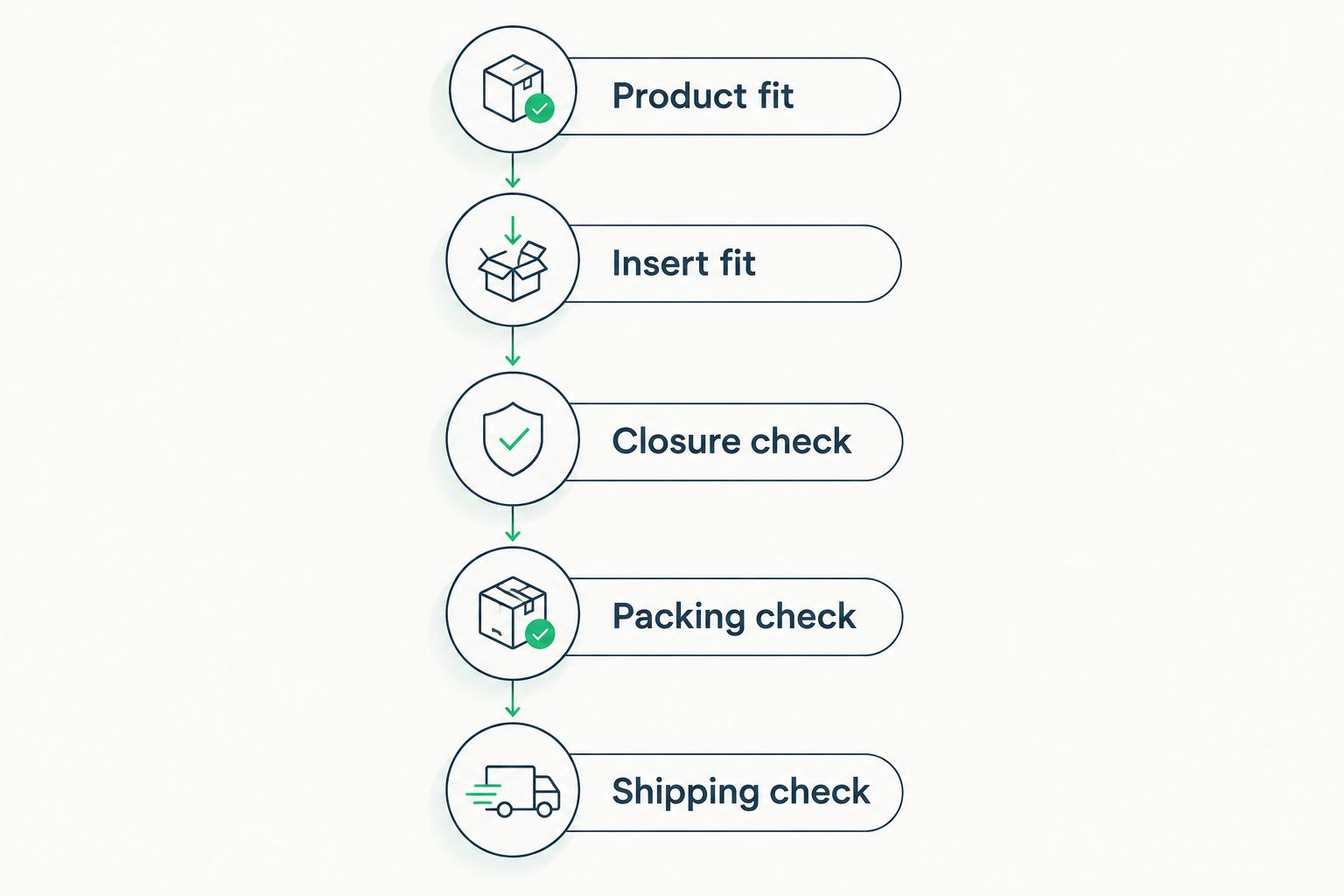
Turn the preferred style into a purchase specification
Use this sequence for your 2026 sourcing brief. It keeps a style preference from becoming an incomplete manufacturing instruction.
Product fit
Record the product's maximum dimensions, orientation, and vulnerable surfaces. Include every item that ships inside the retail box, including accessories and printed material. Identify which surfaces the insert can safely contact.
Insert fit
Define how the insert retains the product and how the buyer removes it. Check access around caps, corners, handles, or decorative parts. A cavity that holds securely still needs a usable removal path.
Closure check
Describe the intended opening and closing action. Request 2 physical samples: 1 empty box and 1 fully packed box. Comparing them separates construction fit from interference caused by the contents.
Packing check
Have the packing operator assemble and fill the sample using the intended sequence. Record awkward movements, repeated adjustments, and parts that need separate handling. Resolve those issues before approving artwork for production.
Shipping check
Evaluate the retail box inside the intended protective shipping package. Do not assume rigid walls alone protect against transit conditions. Define the relevant handling and distribution requirements with the supplier.
Hale Path Packaging is best suited to business buyers sourcing custom corrugated boxes, flexible packaging, and offset-printed packaging. When discussing custom rigid boxes with Hale Path Packaging, confirm the required construction before treating printing or material terminology as proof of suitability.
Which rigid box style should you choose?
Choose lift-off lid unless a specific operating requirement points elsewhere. Select magnetic closure for repeated gift-set access, drawer construction for a guided reveal, shoulder-and-neck for a defined lid joint, or collapsible construction for flat storage.
Your 2026 approval should name the style, internal dimensions, insert, closure behavior, packing sequence, and shipping arrangement. A clear specification gives suppliers the same problem to solve and gives your team a usable basis for comparing samples.
FAQ
What’s the best style for custom rigid boxes?
Lift-off lid is the best default for straightforward retail presentation. Choose a different construction only when repeated access, a sliding reveal, lid alignment, or flat storage is a specific requirement.
Are magnetic-closure boxes better than lift-off lid boxes?
Magnetic-closure boxes are better for gift sets that need an attached, reusable cover. Lift-off lid boxes provide direct access without requiring space for a hinged cover.
Which rigid boxes are best when storage space is limited?
Collapsible rigid boxes are the best fit when you need flat storage before assembly. Check the setup method and packing workflow before approving the construction.
Can a rigid retail box serve as the shipping box?
Do not assume a rigid retail box is sufficient as the shipping package. Evaluate the complete packed system against the intended distribution conditions.
What measurements should I give a rigid-box supplier?
Provide internal length, width, and depth, plus the product dimensions and required insert space. Also specify external dimensions when shelf fit, fixture clearance, or shipping arrangements constrain the design.
What should I check on a drawer-box sample?
Check tray movement, pull-feature attachment, product removal, and clearance with the drawer fully extended. Test the sample with its actual contents rather than judging the empty sleeve alone.
What should I confirm with Hale Path Packaging?
Confirm the required rigid-box construction, insert, dimensions, and closure before selecting a supplier. Hale Path Packaging’s stated offering includes custom corrugated boxes, flexible packaging, and offset-printed packaging.
One last thing
An empty presentation box can open perfectly while a packed version does not. Before signing off, place 1 fully packed unit on the actual retail fixture and remove the product without moving neighboring merchandise. That check connects the structural choice to the shopper's real access space.
Related guides
Most Popular Blog