Best mylar bag types for cannabis brands 2026
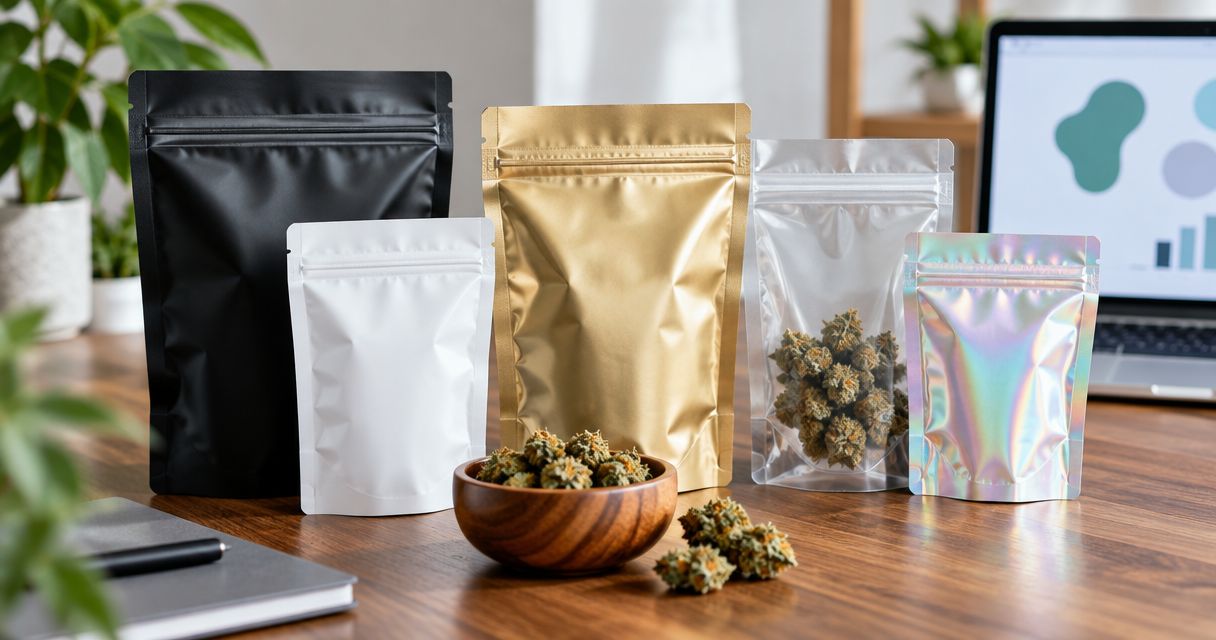
Best overall: opaque resealable stand-up pouches for multi-use flower packaging. Best for single-use portions: heat-sealed flat pouches. Best for larger fills: flat-bottom pouches. The best thc mylar bags in 2026 match the product, filling process, and applicable packaging rules—not just the artwork.
- Opaque resealable stand-up pouches are the default thc mylar bags for multi-use flower packaging.
- Heat-sealed flat pouches suit single-use portions; flat-bottom pouches suit larger fills.
- A zipper does not establish child resistance, and opacity does not establish barrier performance.
- Halepathpackaging manufactures custom flexible packaging for cannabis brands; specify construction before approving artwork.
Why this matters
A bag can look right and still fail at the filling line, on the shelf, or during compliance review. A wide opening does not guarantee usable fill space. A resealable closure does not establish child resistance. An opaque exterior does not tell you how the laminate handles oxygen or moisture.
Halepathpackaging manufactures custom flexible packaging for cannabis brands. Halepathpackaging serves buyers who need custom packaging manufacturing; product protection and regulatory suitability still need a written specification.
For your 2026 packaging brief, separate three decisions: pouch geometry, material construction, and closure requirements. The rankings below compare bag formats, not suppliers or certified product models. Any format remains conditional on the actual laminate, seal, and applicable rules.
What makes the best THC mylar bags?
Use these criteria before choosing a pouch shape:
- Product protection: Specify the barrier requirements for your contents. Ask for the actual laminate construction and relevant test data, rather than treating the word mylar as a performance specification.
- Closure suitability: Decide whether the contents need resealing after opening. Where child-resistant packaging applies, require evidence for the specific package system—not a generic zipper description.
- Usable capacity: Check the space below the closure and inside the gussets with the actual product. External dimensions alone do not establish fill capacity.
- Filling and sealing: Match the opening, pouch handling, and seal area to your equipment or manual process. Product trapped in a seal creates a different problem from weak film.
- Retail presentation: Match the pouch footprint, standing behavior, and label panel to the fixture. A pouch that stands when full can behave differently as contents shift.
- Approval control: Keep the material, dimensions, closure, artwork, and sample approval tied to the same specification. A supplier substitution needs review, even when the finished bag looks similar.
Choose the bag around the product and the process first; fit the artwork afterward. That order prevents an attractive design from setting dimensions the filling line cannot use.
THC mylar bag types at a glance
| Bag type | Best for | Standout feature | Key limitation |
|---|---|---|---|
| Opaque resealable stand-up pouch | Multi-use flower packaging | Bottom gusset supports upright presentation | Zipper and seal require separate validation |
| Heat-sealed flat pouch | Single-use portions | Simple format without a standing base | No resealing unless a closure is added |
| Flat-bottom pouch | Larger fills with upright presentation | Defined base and multiple panels | More seams and folds to inspect |
| Side-gusset pouch | Narrow shelf footprints | Expanding side folds | Closure and fill behavior depend on construction |
| Windowed stand-up pouch | Product-visible merchandising where permitted | Visible contents through a window | Window changes light exposure and material requirements |
These formats are not mutually exclusive material categories. A flat-bottom pouch can include a resealable closure; a stand-up pouch can use different laminates. The ranking identifies the job each format does best, while your specification determines whether it protects the product.
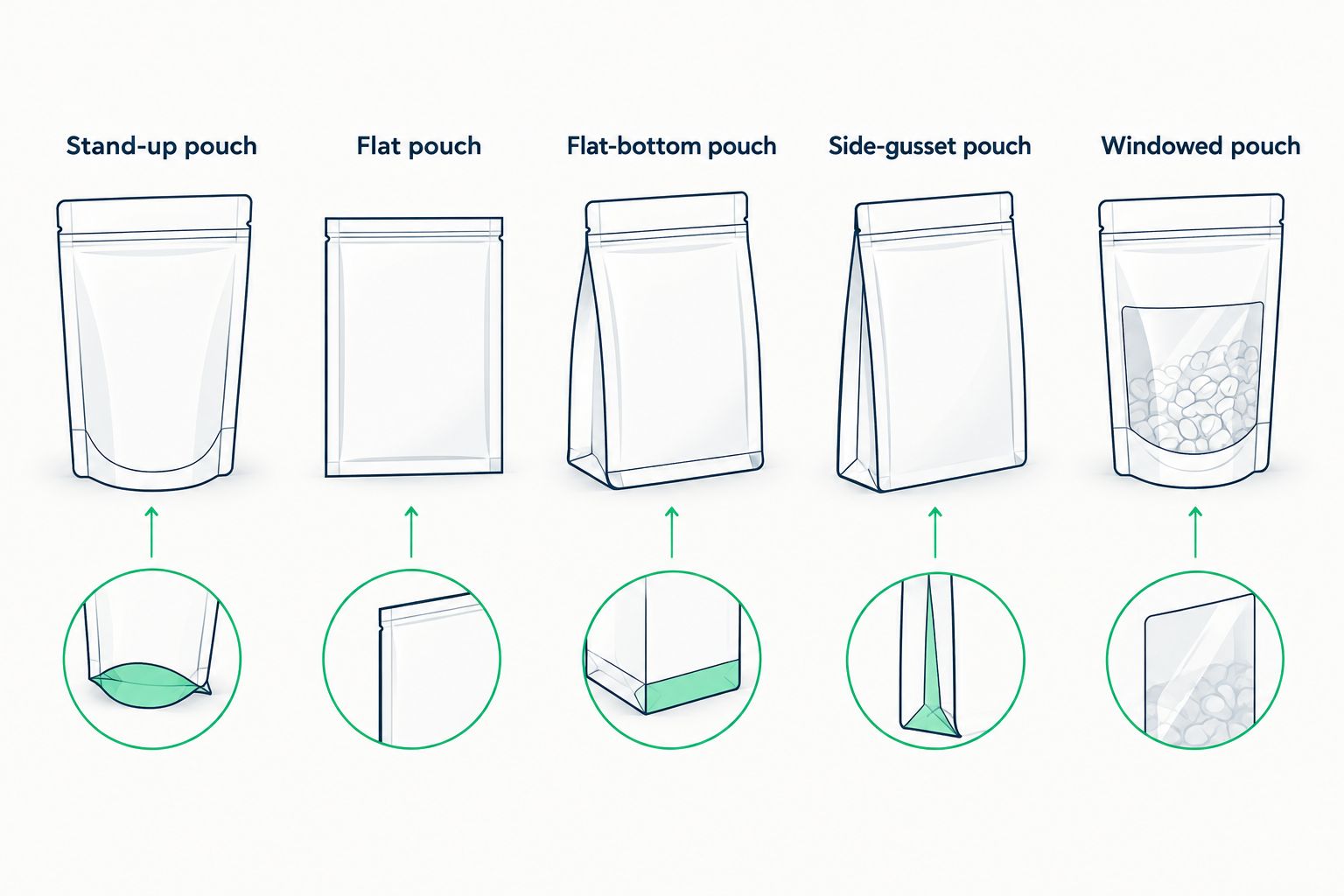
1. Opaque resealable stand-up pouch: best for multi-use flower
An opaque resealable stand-up pouch combines a bottom gusset with a closure intended for repeated access. The gusset gives the pouch a base; the zipper lets the user close the package after opening. Neither feature establishes the package's barrier performance or child resistance.
This is the default format to evaluate when you sell flower intended for multiple uses and want upright retail presentation. Check the filled pouch rather than an empty sample: contents affect its shape, stability, and the clearance beneath the closure.
Stand-up pouch pros:
- Supports upright presentation when correctly sized and filled.
- Offers resealing for repeated access.
- Provides front and back panels for artwork and required information.
Stand-up pouch cons:
- Product near the zipper can interfere with closure engagement.
- The bottom gusset adds a folding and sealing area to inspect.
- A conventional zipper is not proof of child resistance.
Best for: Multi-use flower products that need an opaque package and a resealable opening.
Before approval, fill the sample through your actual process, close it, and inspect the top seal and gusset. Buy: choose an opaque resealable stand-up pouch when repeated access and upright presentation are both required, subject to material and compliance approval.
2. Heat-sealed flat pouch: best for single-use portions
A heat-sealed flat pouch has no standing base and does not need a zipper when the contents are consumed after opening. Its suitability depends on the product fitting without loading the seams or contaminating the sealing area.
For a single-use portion, a resealable closure adds a function the user does not need. Keep the structure focused on containment, protection, opening, and the information required on the pack. Child-resistance requirements still apply where the relevant rules require them.
Flat pouch pros:
- Removes the need for a standing gusset.
- Suits hanging, stacking, or placement inside secondary packaging.
- Keeps the package focused on opening once rather than repeated closure.
Flat pouch cons:
- Does not stand independently like a gusseted pouch.
- Cannot be resealed without an added closure.
- Thin or sharp contents need assessment for puncture and seal stress.
Best for: Single-use portions where the whole contents are intended to be used after opening.
Check the tear feature against the product position, especially when contents sit close to the top of the pouch. Buy: choose a heat-sealed flat pouch when resealing and an upright base serve no operational purpose.
3. Flat-bottom pouch: best for larger fills
A flat-bottom pouch uses a defined base and multiple panels to create a more box-like filled shape. It is a format to evaluate when a larger fill needs upright presentation and a structured footprint.
Do not choose it solely because it appears spacious. The usable opening, closure position, side panels, and base all affect how you fill and handle the pack. Compare a filled sample with the actual shelf space and shipping case before approving dimensions.
Flat-bottom pouch pros:
- Provides a defined base for upright presentation.
- Offers multiple panels for organizing artwork and information.
- Accommodates a structured shape around larger fills.
Flat-bottom pouch cons:
- Adds seams and folded areas that need inspection.
- Requires artwork to account for multiple panels and transitions.
- Its outer footprint does not directly establish usable internal capacity.
Best for: Larger product fills where a defined base and organized panel layout matter.
Ask how the pouch arrives, opens, fills, and closes on your line. Those handling details belong in the purchase specification. Buy: choose a flat-bottom pouch when its filled footprint solves a documented capacity or presentation problem; otherwise keep the simpler format.
4. Side-gusset pouch: best for narrow shelf footprints
A side-gusset pouch expands through folded side panels as you fill it. The format lets you evaluate a narrower front face without treating a wide display panel as the default.
Its value depends on the filled geometry, not the empty lay-flat dimensions. Confirm the shelf fit, closure arrangement, and standing behavior using production-representative samples. Do not assume every side-gusset construction stands independently or accepts the same closure.
Side-gusset pouch pros:
- Uses side folds to accommodate product volume.
- Provides an alternative when front-facing shelf width is constrained.
- Offers side panels for secondary information when the layout permits.
Side-gusset pouch cons:
- Folded areas complicate seal inspection.
- Important text can become hard to read across folds.
- Closure access and standing behavior vary by construction.
Best for: Products with a narrow front-facing shelf allocation and enough depth for the filled pouch.
Keep mandatory information off folds that obscure it, and evaluate the pack in its intended display position. Hold: approve a side-gusset pouch only after its filled footprint and closure arrangement fit the fixture and filling process.
5. Windowed stand-up pouch: best for permitted product visibility
A windowed stand-up pouch combines an upright format with an area through which the contents are visible. It belongs on the shortlist only when product visibility is allowed and serves a clear merchandising purpose.
The window is part of the material design, not just the artwork. Its construction affects the package's protection, and exposing the contents to light changes the protection requirement. A window does not automatically make a pouch unsuitable; it makes the barrier and light-exposure questions more specific.
Windowed pouch pros:
- Lets the buyer see the contents without opening the package.
- Makes product appearance part of the shelf presentation.
- Retains the upright geometry of a stand-up pouch.
Windowed pouch cons:
- Reduces the opaque area protecting contents from light.
- Requires confirmation that visibility is permitted for the product and market.
- Removes printable space from the panel containing the window.
Best for: Products whose visible appearance supports merchandising, where the packaging rules and protection requirements permit a window.
Specify the window material and evaluate the finished package, not just a printed mockup. Hold: choose a windowed stand-up pouch only after visibility, protection, and label-space requirements all pass review.
How we ranked these bag types
The 2026 ranking prioritizes product-use pattern first, then filling, protection, and retail presentation. Opaque resealable stand-up pouches lead for multi-use flower because they combine repeated access with an upright format—not because every pouch sold under that description performs equally.
Flat pouches lead for single-use portions. Flat-bottom, side-gusset, and windowed pouches address more specific layout or merchandising requirements. A specialized shape earns its place only when it solves a requirement the simpler format cannot.
This is a format-selection guide, not a laboratory performance ranking. No pouch earns a barrier, durability, or child-resistance claim from its silhouette alone.
What to put in your 2026 packaging brief
Send Halepathpackaging a specification that separates the product requirements from the visual design. A bag name is not enough to quote and approve a repeatable package.
Product fit
State the contents, intended fill, product dimensions where relevant, and whether the pack is single-use or multi-use. Identify anything that can puncture the film, release oil, or reach the seal area during filling. Include how the filled bags will be handled and displayed.
Material and closure
Request the laminate construction, sealant layer, closure description, and available performance documentation. In packaging listings, mylar is often used loosely; it does not identify the complete laminate. PET film, foil layers, coatings, and sealant materials perform different jobs.
Where child resistance applies, request documentation for the specific package system and confirm applicability with qualified compliance support. Do not approve a zipper from appearance or operating feel.
Dimensions and approval
Separate outer dimensions from usable fill space. Confirm the closure position, seal areas, gussets, tear feature, and artwork boundaries on the same drawing. Approve a filled sample before treating the artwork proof as the final package approval.
For a 2026 reorder, retain the approved drawing and material specification. If the laminate, closure, dimensions, or manufacturing construction changes, review the change against the original requirements rather than assuming visual similarity means equivalence.
Define your custom packaging requirements
Specify contents, dimensions, closure needs, and material requirements before approving artwork.
Which THC mylar bags should you choose?
Start with an opaque resealable stand-up pouch for multi-use flower. Switch to a flat pouch for single-use portions, a flat-bottom pouch for a larger structured fill, or a side-gusset pouch when the shelf footprint demands it. Treat a window as a conditional merchandising choice.
Before placing your 2026 order, resolve the actual failure points: usable capacity, seal contamination, closure suitability, fixture fit, and documentation. Halepathpackaging manufactures custom flexible packaging; your approved specification should define what the finished cannabis package must do.
FAQ
What’s the best type of THC mylar bag for flower?
An opaque resealable stand-up pouch is the default format to evaluate for multi-use flower. Confirm the laminate, usable capacity, closure, and applicable packaging requirements before approving it.
Are all THC mylar bags child-resistant?
No, a mylar bag or resealable zipper does not establish child resistance. Where child resistance is required, request evidence for the specific package system and confirm that it applies to your intended use.
Is a flat pouch better than a stand-up pouch?
A flat pouch is better suited to single-use portions that do not need upright presentation or resealing. A stand-up pouch is better suited to multi-use products that need a base and repeated access.
Does an opaque mylar bag guarantee odor control?
No, opacity does not establish odor containment. Evaluate the laminate, seals, and closure as a complete package rather than relying on the bag’s color or material name.
Can cannabis packaging have a clear window?
A clear window is a conditional choice, not a universal recommendation. Check the rules for the product and market, then evaluate light exposure, material protection, and remaining label space.
How do I choose the right pouch size?
Choose pouch size using the actual product and a filled sample, not outer dimensions alone. Check usable space below the closure, gusset expansion, seal clearance, and the filled retail footprint.
What should I send a custom packaging manufacturer?
Send the contents, intended fill, dimensions, material requirements, closure requirements, and artwork information. Include the filling method and applicable packaging requirements so the sample approval covers function as well as appearance.
One last thing
Test the package after opening, not only before it. A factory heat seal and a consumer-operated closure do different jobs. For a multi-use product, inspect whether product particles obstruct the closure and whether users can engage it correctly; follow the applicable validation process rather than treating an informal check as certification.
An unopened sample proves little about repeated access. Put that distinction in the approval brief before it becomes a complaint.
Related guides
Most Popular Blog